A House of Dynamite
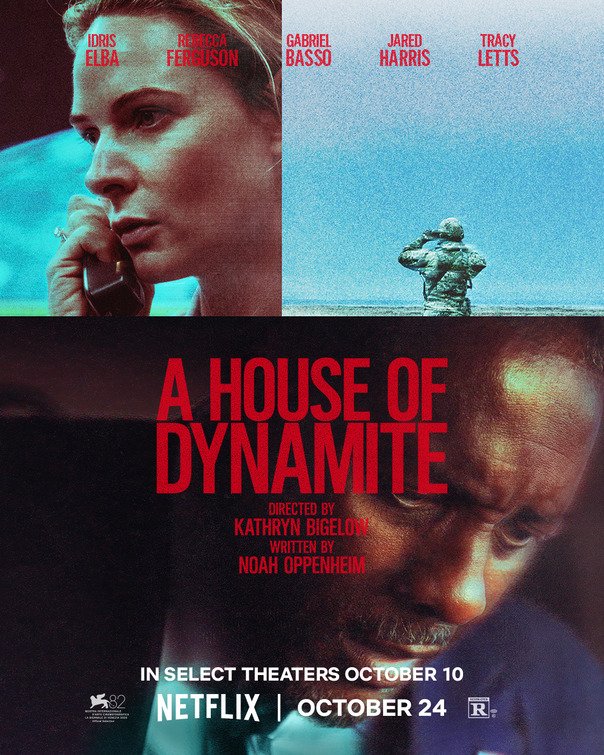
Kathryn Bigelow returns after nearly eight years with A House of Dynamite. Her work includes critically acclaimed The Hurt Locker (2008), Zero Dark Thirty (2012), and the underrated Detroit (2017). Her films explore engaging, thought-provoking, and morally complex narratives.
A House of Dynamite follows the American government’s response to a nuclear attack from an unknown agent, one which is heading for Chicago. The country has 18 minutes before the missile hits, the story is told and repeated from four different perspectives over the same period.
From the trailer, this looked exciting, using tropes familiar in drama. Control rooms filled with large screens as government employees watch in horror, devising various plans to try and save the country, watching as the nuclear missile flies ever closer.
All of which is compounded by the tension from a brilliant cast, with names like Rebecca Ferguson, Jared Harris, Greta Lee, and Idris Elba starring in this drama. As I really like most of these actors, associating them with premium films and series, I knew I had to see this.
As an opening, it’s informative. We know exactly what’s happening, what the stakes are, and get the emotional backbone of the film through Rebecca Ferguson and Jared Harris’s characters, both of whom have families in Chicago.
I was hooked by the first story, intrigued by the second as I didn’t know it was a non-linear structure, but by the third, my intrigue was replaced with frustration as the story hadn’t delved any deeper.
Now, if this was directed by Roland Emmerich, known for Independence Day, then I’d be more sympathetic to the film, expecting spectacle over any substance. But Bigelow is known for her profound observations of character and subjects, so what happened?
Bigelow’s intention, which I found out after finishing the film, was to give us a ‘what would you do in this moment?’ to debate amongst ourselves. The flaw in the plan is that there isn’t enough substance to do any such thing.
The film lacks any strategic options, informed ideas, something of note that we could grapple with beyond the obvious – a nuclear war is horrifying and has devastating repercussions.
I would hope that this film isn’t the nudge you need to talk about nuclear war.
It relies too heavily on its repetitive four-act structure, treating it as the main source of tension rather than building a deeper narrative. What it needed to do was be less about style and more about strengthening the script into a clearer linear story, one that tackled any relevant issues about nuclear war, of which there is an abundance.
Compared with Oppenheimer or the horrifying events in the series Chernobyl, where ethics, human error, and the catastrophic consequences of nuclear fallout are so well told, A House of Dynamite feels disappointingly lacklustre – a potentially profound story reduced to a rudimentary thought exercise.
A House of Dynamite is available on Netflix