The Running Man
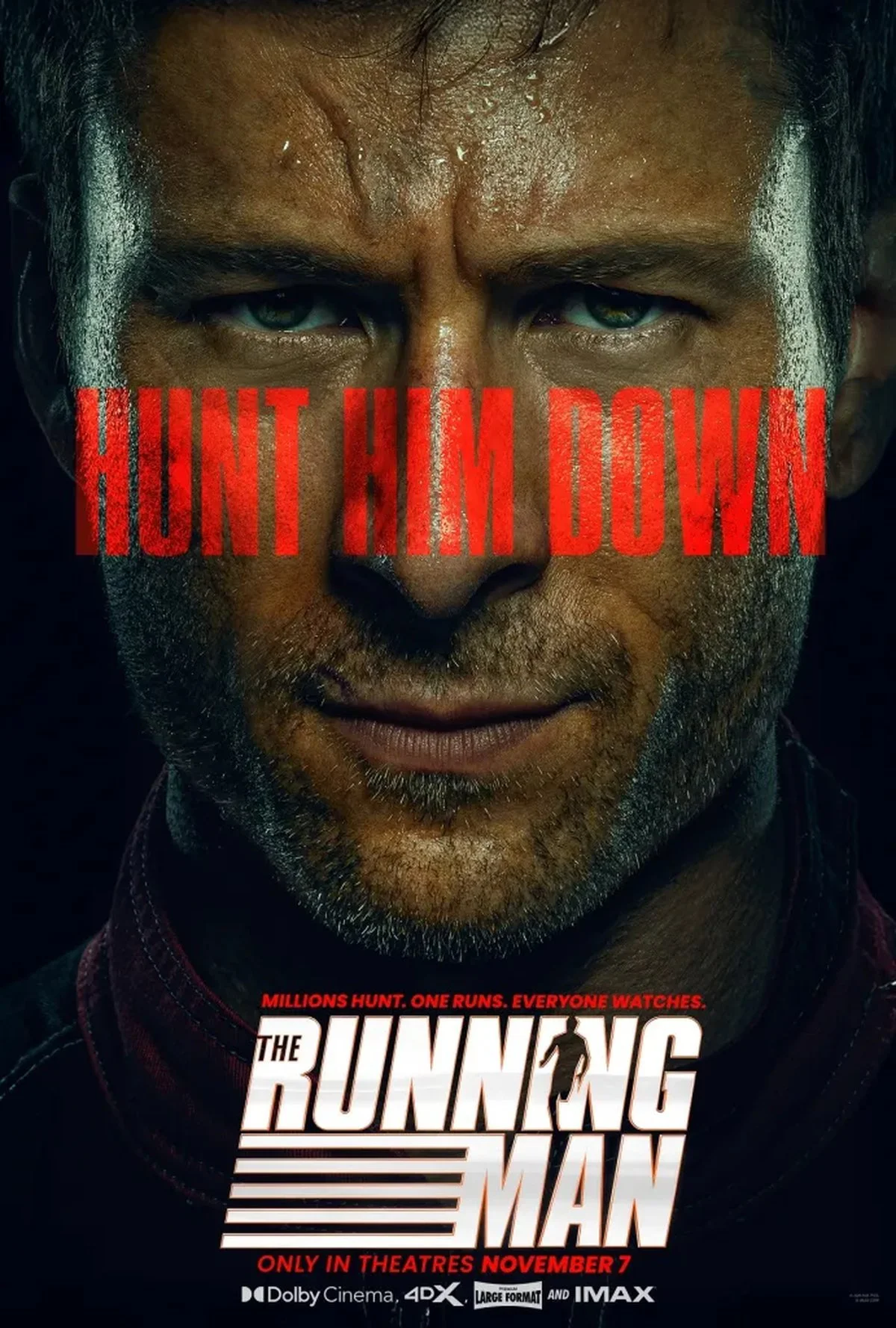
Like a long run, The Running Man can be fun in places, but if you’re not careful you can really be aware of how long it’s taking to finish.
Set in a version of 2025 where dangerous game shows are a chance for the underprivileged to win huge amounts of money at great personal risk. Ben Richards (Glen Powell) is a father struggling to pay the bills for his family and for his daughter’s medication. He’s just been fired from his job as an oil rig worker – which the film uses to explain away his overly muscly physique.
To help his family he signs up for The Running Man game show. The aim of the game is to survive for 30 days while being pursued by hunters, aided by members of the public who can film or photograph contestants to give away their location. And each day the contestants must send a self-tape to keep audiences engaged – like reality TV devoid of ethics and morals.
This should be a roller-coaster of a film, albeit a dark one. You’ve got an accomplished director with Edgar Wright at the helm, and one of the next big Hollywood stars as your leading man. While I enjoyed parts, the futuristic Blade Runner aesthetic of the world and the supporting cast of Colman Domingo and Josh Brolin, who kept the party going, I kept finding the same faults.
I think Glen Powell is a strong choice for the lead. Like most action blockbusters you need a solid leading protagonist, someone attractive and charismatic who you can root for. Powell is perfect for this, with tons of charisma and charm, I just don’t think he landed this role as Ben Richards.
In the first scene, Richards is holding his daughter, he’s just been fired by his boss, and while he retains a modicum of calm, he’s also repressing a lot of understandable frustration from the social economic problems he’s facing. He slams his hand on his boss’s desk, outraged that he’s been fired. But it’s the most underwhelming slap, and it’s this that encapsulates my biggest critique.
The opening 20 minutes are formulaic, which is fine, we need to set up the premise to get to the action. But when we do, it’s plagued with plot holes, and some of the best scenes were shown in the trailer.
Richards’s self-tapes quickly become political – angry at a system that treats the powerless and desperate as entertainment. But the game show, referred to as ‘the network’, doesn’t want Richards to be a figure for the disenfranchised to rally around, so they use AI to alter his message to make him the enemy. It’s clever, but rather than using it once as a plot twist at the end, it repeats itself so the film quickly feels repetitive and stale.
The theme of social injustice is at times well done, with the aesthetic and contrasting displays of wealth. The electric, flamboyant hosts of the Network, giving it a Hunger Games vibe, are contrasted nicely with the downtrodden desperation felt by Richards, his family, and the other contestants lining up in droves for a chance to play a game to the death.
But there are also small inconsistencies that stand out as feeling unintentionally out of place. In one scene Richards is preaching to a woman whom, out of desperation, he has kidnapped. He starts preaching to her about social injustice, using her expensive scarf as an example. But it’s hard not to notice his brilliantly white teeth, which undermines the moment – it feels too Hollywood and akin to the hosts of the Network rather than the underprivileged.
Despite these flaws, there’s some levity, some of the action scenes are fun. And when Michael Cera’s character Elton Perrakis drops in, it finally feels like an Edgar Wright film. Cera’s scenes are fun, with Home Alone style traps, witty dry dialogue. He plays well against Richards as chaos reigns down around them to the soundtrack of his mother cackling in the background. It’s what this film needs more of, which is not to say a director must always stick to their signature style, but here it would have really helped make it a bit more fun.
This dystopian film is at times fun, and it tries to convey a greater heart, but never successfully evolves the themes beyond the same notes. At the time when the chase should be the most exciting part, it instead feels flat. Rushing its ending despite the 2-hours 13-minute runtime. It desperately needed to be less a faithful adaptation of a Stephen King book, and more of an Edgar Wright vehicle for him to have fun with.
The Running Man is available on the Apple Store.