Hamnet
Since I was a child, I’ve loved stories for their power to connect us with people beyond our own experiences, which in turn illuminate our own lives.
Hamnet is an adaptation of the book by Maggie O’Farrell, and she’s worked with director Chloe Zhao to translate this to film. It turns a non-linear story linear and adds new sections. This isn’t chapter and verse; it’s a reimagining that sharpens its very human power.
The film focuses on the love story between Agnes (Jessie Buckley) and Will (Paul Mescal). Set in 16th century England, we watch their taboo love blossom into the most joyous family who are forced to grapple with the unimaginable horror of their son Hamnet’s death.
Every hour, every minute, every second of this film has been meticulously combed through. Its scenes are woven together in a tapestry that celebrates life, love, and accepts death as equally prevalent in the natural order – as painful as it may be.
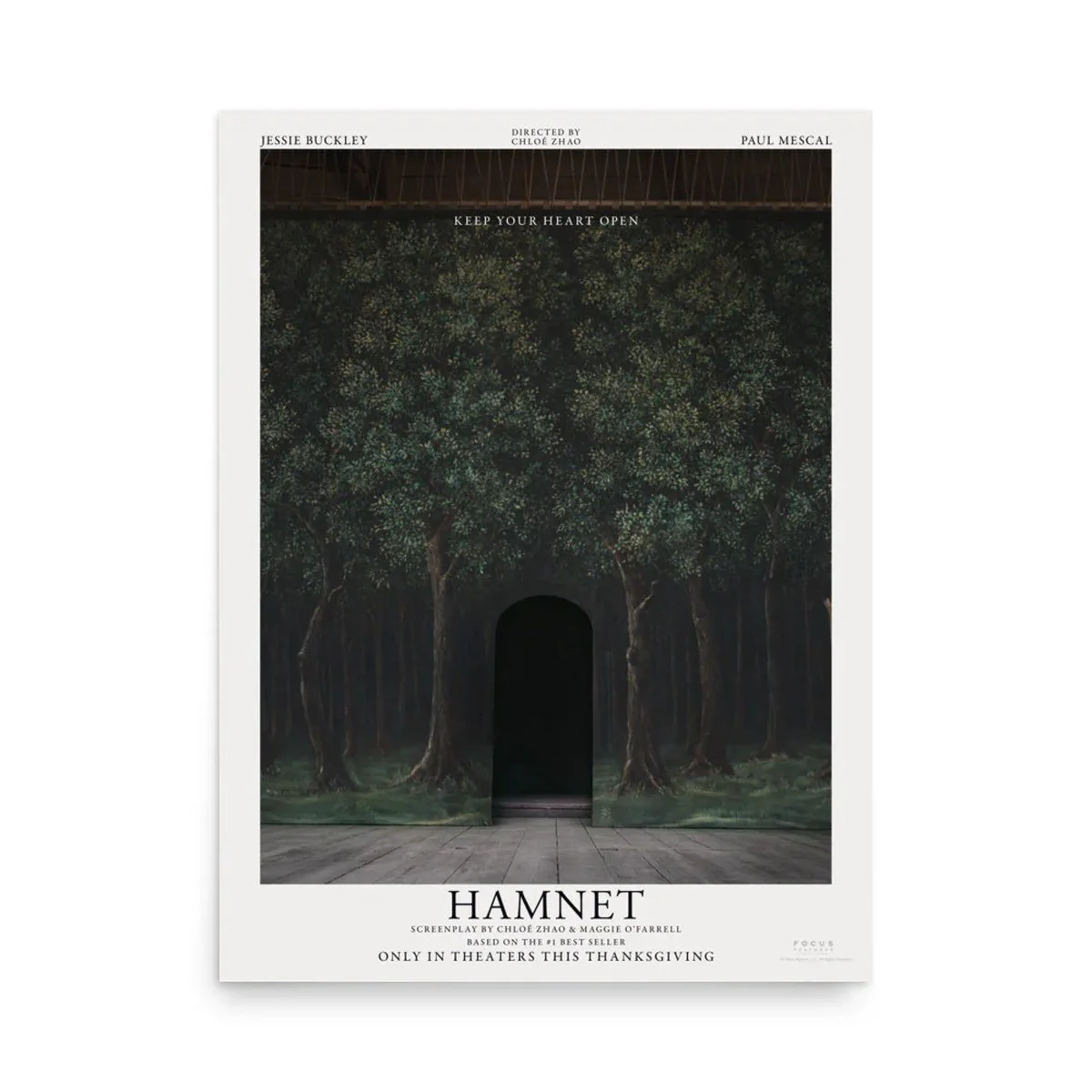
The film opens with a shot of a beautiful tree canopy, branches and leaves interlaced, so that the most vivid green, backlit by the sun, fills the screen. The camera slowly pans down, showing two thick, sturdy trunks, before revealing their intertwined roots, where Agnes is resting in a foetal position, nestled in nature.
This is a story that leads to the creation of the play Hamlet. But the greater focus is Agnes – because while grief is shared by all affected, nothing is as keenly felt as a mother’s love, nor is as unimaginable and as harrowing as the death of her child.
Agnes comes from a line of women who are born in nature and emerge as these mythological creatures so in tune with life. They understand the alchemy of ingredients that grow naturally; plants, mushrooms, herbs, and so can create medicines that work more effectively than anything prescribed by doctors of the time.
They have great empathy and understanding of the world. A sense that connects them with animals and enables them to see the path a person’s life will take by holding their hand. In an era constricted by religion, she’s often seen as nonconforming – therefore wild and unpredictable.
Will, on the other hand, suffers a different hardship. Brought up in a more traditional setting, he’s beaten and trapped by his bully of a father, working as a tutor to pay off his father’s debt and labelled as useless. Will is perpetually stuck in his own mind, struggling to turn his vast imagination into words. When Agnes and Will find each other, it’s the start of their liberation.
Now I know it’s become a cliché, Mescal playing into the sad boy motif, but with the right material it’s effective. Look at All of Us Strangers. I think he’s at his best when he’s a contemplative vessel for this character’s grief and anger whilst supporting the bigger performance.
This makes him the perfect scene partner to let Jessie Buckley thrive – her performance as Agnes is monumental. This isn’t to say she only works because of Mescal. I think they feed each other, and I can’t imagine any other pair doing this so well.
There’s no ego here – something you might get with other actors. There isn’t a need to try and outdo each other to have their moments. Mescal and Buckley read off each other’s instinct and energy perfectly to deliver the most real and grounded performances. All aided by a script that’s filled with humanity, clever observations, rich poetic language, and honesty.
Buckley must convey all this and more, as a character mistrusted by society but firm in her belief. To know the path her life must take, and grapple with the implications of possibility. For instance, she knows two of her children will stand by her deathbed, but after the birth of her first child she has twins.
She sees the greater natural order of life, grappling with what she wants against what she knows. It’s all folded into her absolute need as a mother to keep her children alive. It’s this balance and understanding of nature, of life, of death, that makes the second half of the film hit so hard.
Buckley delivers all this in the most complex and rich performance to become the beating heart of this film. When you watch her, it’s like seeing an old soul, every expression, every look, every movement, is filled with such rich depth. She’s rightfully won a BAFTA; now she deserves the Oscar. To me, her performance is perfection.
The other actor I must mention is the beautiful boy Jacobi Jupe who plays Hamnet. For a 12-year-old, the film demands so much emotional wisdom from him to deliver key moments – he’s utterly mesmerising. I love the stoicism and playfulness he embodies with Paul Mescal’s Will, but like a lot of this film, the strength and poetic poignancy is in the vulnerability. His scenes with Jessie Buckley just resonate on another level.
What’s also so particularly engaging in the second half of the film is the way in which pain and grief are explored in different forms. Emily Watson as Mary, Will’s mother, gives us the perspective of an aged grief, of an acceptance that will never quite heal, a pain living just below the surface – she will carry it in whatever form that takes. And there’s Mescal’s character Will. His long absences from home mean he’s not there for vital moments and must find his own manner to grieve, which he does through his writing. This is how Hamlet is born.
I can’t imagine anyone else taking this subject and handling with such delicate care, empathy, and understanding as director Chloe Zhao has. Frame for frame, emotion for emotion, there is so much to convey as an adaptation. To fine-tune that balance between being faithful to the book as much as create something that stands in its own right is a stupendous skill.
Zhao has perfectly orchestrated a powerful performance from the cast and found the most emotive music to accompany it all – I may never hear On the Nature of Daylight in the same way. It’s all wrapped up in this insight and examination of the rawest form of emotion and humanity. A rich story that observes life so exquisitely and cuts to the centre of our humanity. Zhao gives the film a sensibility and perspective that’s both human, as it pertains to conveying tragedy, and unique in her artistic style, to go through the emotions in a way that helps us comprehend it.
The final scene is one of the most heart-wrenching I’ve ever seen. Powerfully poetic with such an array of emotional complexity, it’s staged and blocked out perfectly. Delicately wrapped up for us, for the characters, and for the film to hurt, to grieve, to heal, and to find acceptance. With Jessie Buckley at the beating heart.
Hamnet isn’t an easy film to watch because grief is just as prominent a character as the cast. But there’s a measured catharsis to exploring the joy, love, and horror of life within a 2-hour runtime. When the credits roll, you’re left stunned and deeply moved.
I’ve seen it twice so far, and with each rewatching I’m better at articulating my relationship with this film. It’s been a profoundly moving experience, taking me places I hadn’t anticipated, but truly love and appreciate. I’m not sure I would have coped, but I wish I’d seen this in the cinema. Strangers crying in the dark, a collective catharsis.
Keep your heart open